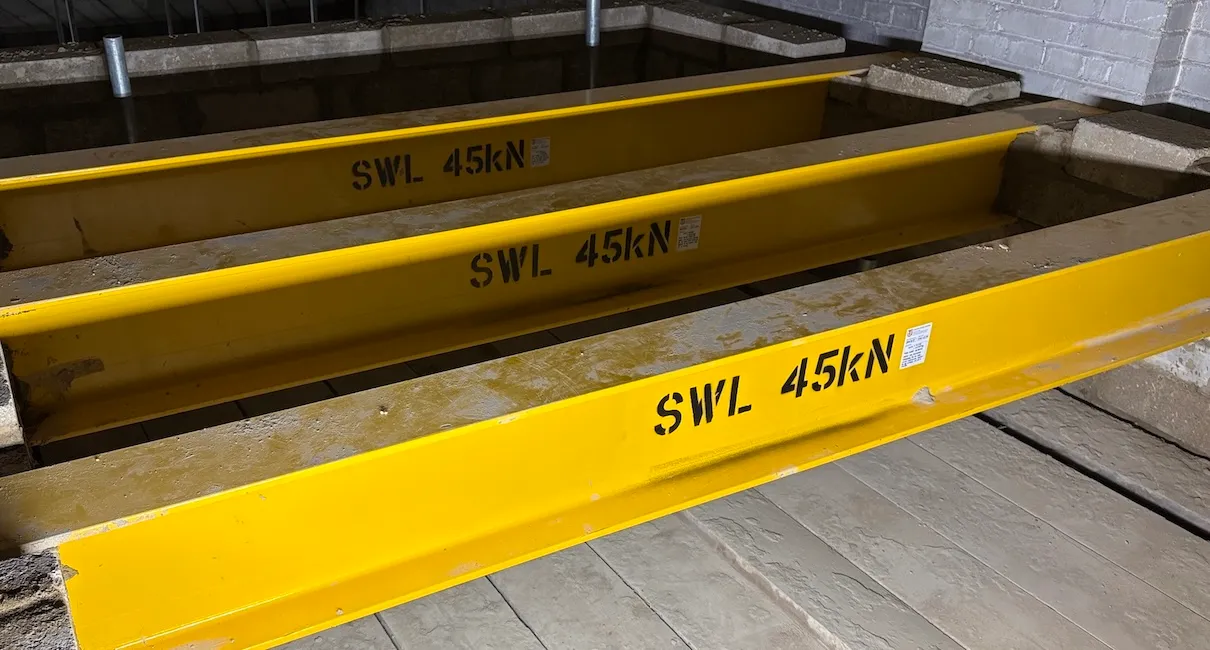
London Fixing Testing Ltd provides independent on-site beam testing to verify the load capacity, performance, and structural integrity of beams under applied loads. Under LOLER (Lifting Operations and Lifting Equipment Regulations 1998), lifting beams and runway beams must be thoroughly examined and proof load tested before use. Beam testing offers reassurance that installed beams perform as designed and meet project, safety, and regulatory requirements.
Beam testing to BS 2853 consists of an SWL test and a proof load test.
The SWL is the Safe Working Load of the beam, typically stipulated by the designer, and the load the beam can be subjected to in its day to day use. The SWL test involves loading the beam to its SWL including the weight of the heaviest lifting appliance to be used on it.
The proof load test is conducted after the SWL test. The beam is subjected to its SWL multiplied by 1.25, plus the weight of the heaviest lifting appliance.
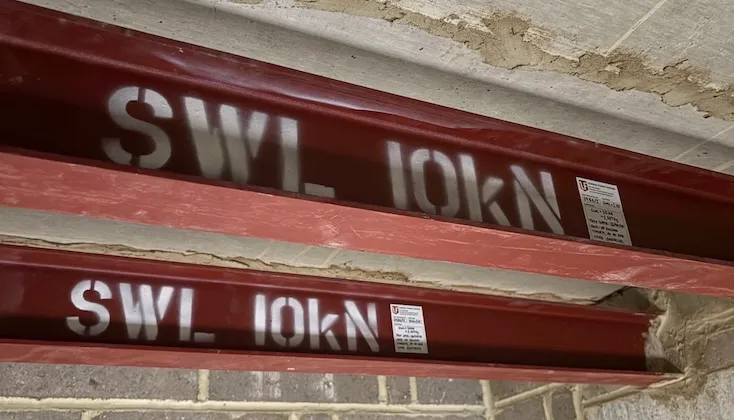
The beam is inspected before, during and after load testing. If the beam complies with load test requirements, it is stamped with its SWL, a reference sticker attached with further test information, and a BS 2853 and LOLER compliant certificate issued with a test report, all signed off by the test engineer.
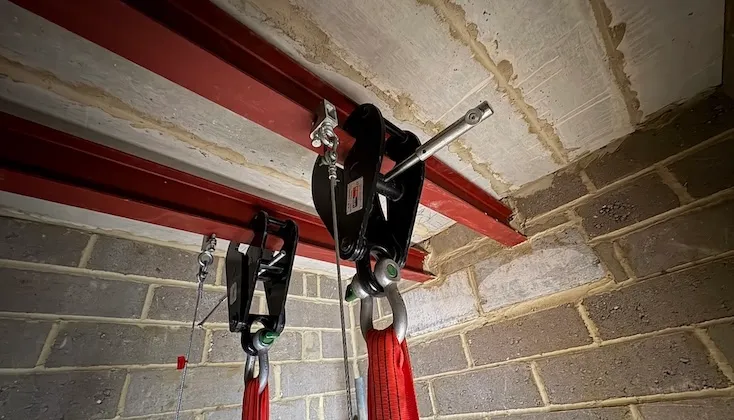
Most commonly our clients ask us to test 'lifting beams' or 'runway beams'.
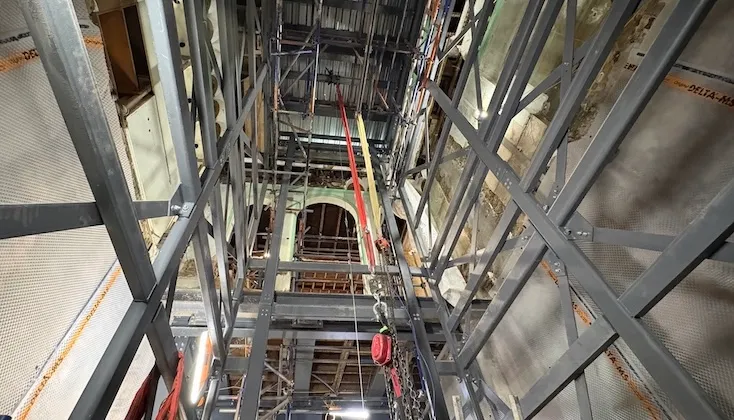
In this context, a lifting beam refers to a beam installed at the top of a lift shaft or motor room, and used to hoist the lift equipment into position. The lifting beam is typically fixed at each end into the lift shaft walls.
A runway beam is usually found in a workshop, factory or warehouse, and used to move loads along its length, with the use of a rolling trolley. The runway beam is likely to be fixed at multiple points along its length.
The formal definitions of beam types are detailed within the LEEA (Lifting Equipment Engineers Association) 'Code of practice for the safe use of lifting equipment'.
Our beam testing is undertaken in accordance with relevant industry standards and project specifications, including:
All testing is planned and executed in consultation with the project team to ensure safety and compliance at each stage. In addition to your degree qualified civil engineer having more than 15 years experience in beam load testing, they are also LEEA trained with CSCS, IPAF, PASMA and working at height qualifications for safer working on your site.
Reports are issued within 24 hours to support approvals, sign-off, and project progression. Following completion of testing, the beam is stamped with its SWL, and the reference sticker attached. We provide a comprehensive BS 2853 and LOLER compliant certificate and test report, which includes:
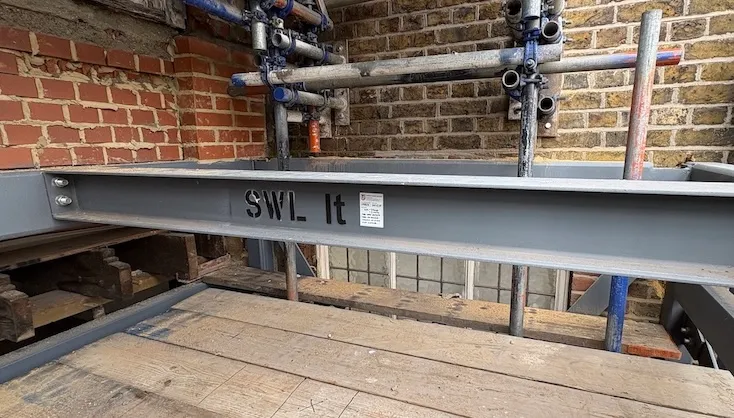
We work closely with engineers, contractors, and building owners to deliver fast and reliable beam testing, safely and efficiently. From your first call to report issue, every part of your job will be handled by an experienced engineer.
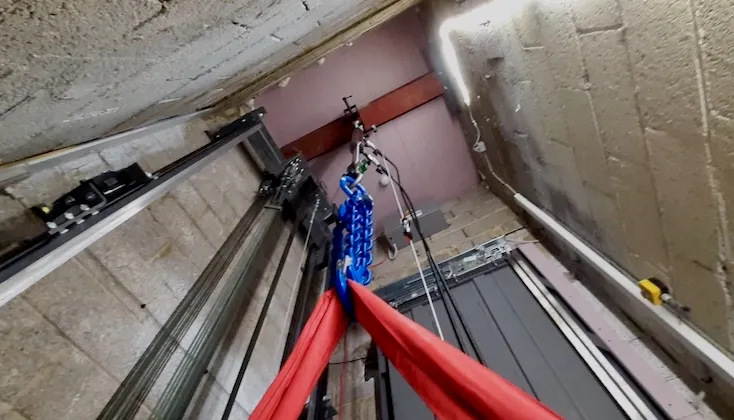
Beam testing is often specified:
If you are unsure whether beam testing is required for your project, our team is available to advise.
Sectors we work in: Residential | Retail | Hotels | Historic & Iconic Buildings | Transport | Education | Medical | Sports & Leisure | Energy & Infrastructure | Parks & Gardens
Shangri-La Residence, St John's Wood Square, Southbank Place, Sugar House Island, Barking Riverside

The O2, Harrods, Canary Wharf, Westfield, Liberty's, Marks & Spencer, Sainsbury's

Claridge's, The Savoy, Mandarin Oriental, The Westbury, The Berkeley

Battersea Power Station, British Library, The Shard, BBC Television Centre, Brettenham House, Smithfield Market

London Heathrow Airport, London King's Cross, London Bridge, London St. Pancras Stations

Imperial College, University of Hertfordshire, Highgate School

Charing Cross, Great Portland Street, Hammersmith, Royal Berkshire, Royal Marsden

Twickenham Stadium, Newbury Golf Club, Fulham F.C. Craven Cottage
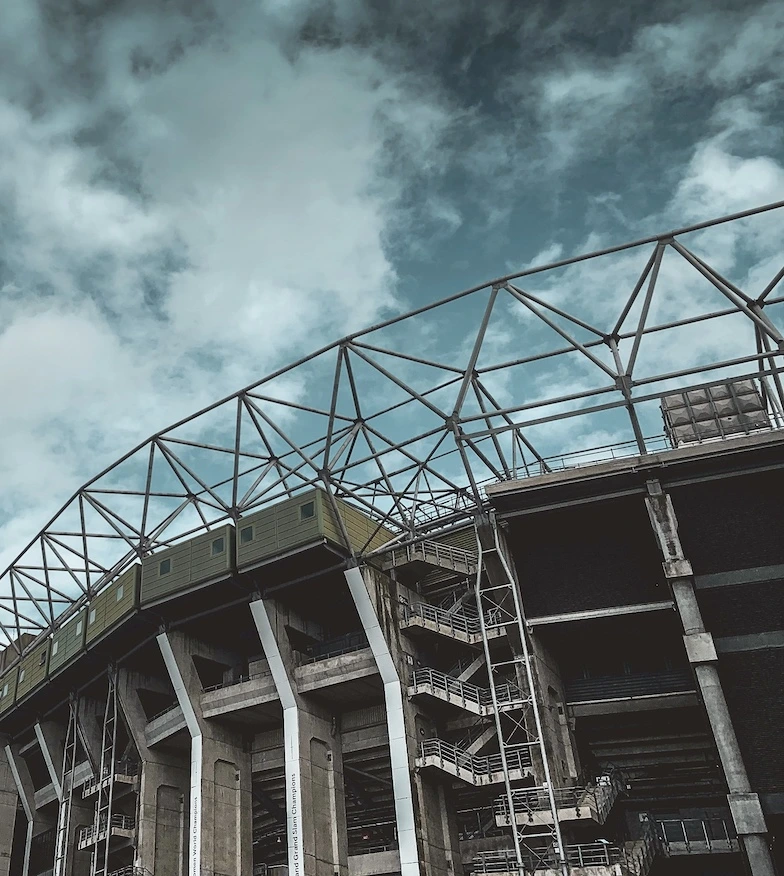
Thames Tideway, Navigator Terminals Thames, Sharnbrook Viaduct, Thurrock Energy Storage
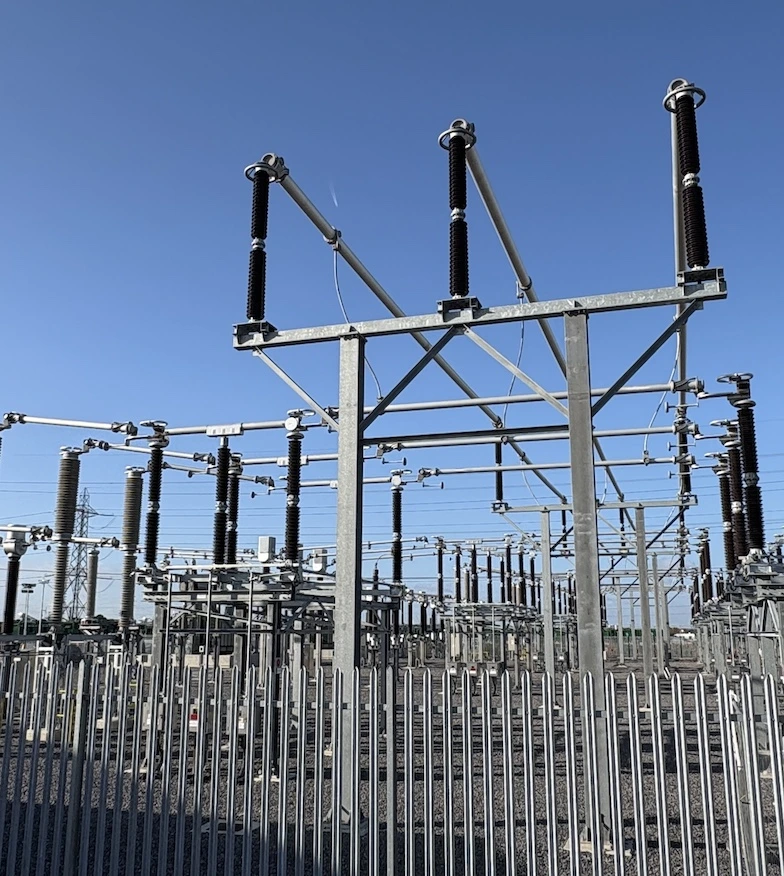
Lower and Upper Grosvenor Gardens, Bessborough Gardens, St Marylebone Parish Gardens

For urgent work we offer a same day test and certification service (subject to availability). Typically we can attend site within 2–3 working days. Call us to discuss your requirements.
Most beam tests are completed within a single shift on site. The exact duration depends on the number of beams, number of supports along the beam, loading requirements, and site access. Our engineers will confirm test duration over the phone.
We provide testing services in and around London, and travel across the UK for larger scale or more complex projects.
A same-day certification and reporting service is available for urgent projects. Test reports and certificates are issued the next working day for standard bookings.
Typically this is not required, as we gather necessary information via a phone call or an email.
Yes. We regularly test existing beams where capacity needs to be verified for increased loads, change of use, or where original documentation is unavailable.
Yes. Temporary works beams, including those used during construction and demolition, can be load tested and certified prior to use.
Yes. We can test multiple beams in a single site visit, which is more cost-effective and minimises disruption on-site. Let us know the full scope of works when you get in touch.
Yes. Under LOLER (Lifting Operations and Lifting Equipment Regulations 1998), lifting beams and runway beams must be load tested and thoroughly examined before first use.
LOLER (Lifting Operations and Lifting Equipment Regulations 1998) applies to any equipment used for lifting, including lifting beams and runway beams. It requires that such equipment is thoroughly examined, load tested, and certified as safe, before use.
An SWL test verifies that a beam can safely support its rated maximum working load, within the deflection to span limits defined within BS 2853.
A proof load test applies a load greater than the beam's intended Safe Working Load (SWL) to verify that the beam can safely carry its design load without excessive deflection, distortion, or failure. The proof test load is equal to the SWL multiplied by 1.25, plus the weight of the heaviest lifting appliance to be used on the beam.
Deflection is measured using calibrated displacement gauges or dial indicators at defined positions throughout the test.
Whether it's pull out testing of Hilti, Fischer or Rawlplug anchors, SWL testing of lift shaft beams, or pull off adhesion testing of screeds, tiles, or coatings – we handle it all with zero hassle.
Get peace of mind and total compliance today.
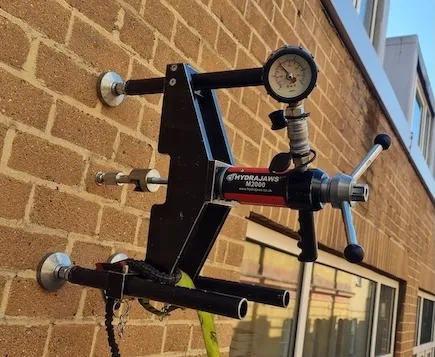
Fixings pull testing, pull out testing or anchor testing. Whatever you call it, we do it!
Tensile testing of fixings to BS 8539 and CFA guidelines.
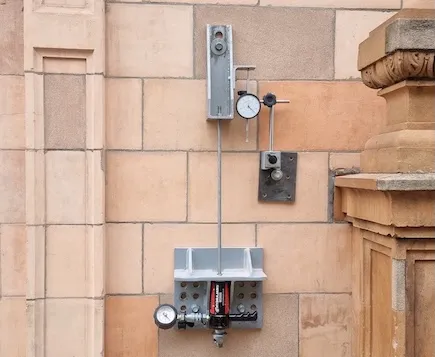
Shear load testing of fixings, anchors & brackets.
Lateral testing of fixings to BS 8539 and CFA guidelines.
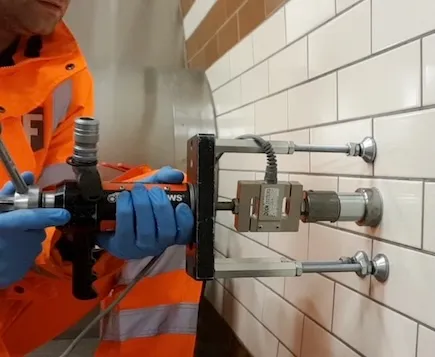
Pull off testing of coatings, screeds, tiles and adhesives.
Tensile testing to client specification and applicable standards.
